-
Hotels
-
By Location
- - Arenal Volcano (La Fortuna)
- - Monteverde
- - Papagayo Gulf
- - Flamingo / Tamarindo
- - Guanacaste, Liberia
- - San Jose City
- - Near International Airport
- - Cahuita & Puerto Viejo
- - Tortuguero
- - Manuel Antonio
- - Jaco Beach
- Other Locations...
Northern RegionNorth Pacific RegionCentral ValleyCaribbean CoastCentral Pacific - Category
- Budget
- Main Cities
-
By Location
- Vacations and Activities
- Where to Go
- Transportation
- Costa Rica Info
-
Maps



SWEET TROPICAL DREAMS
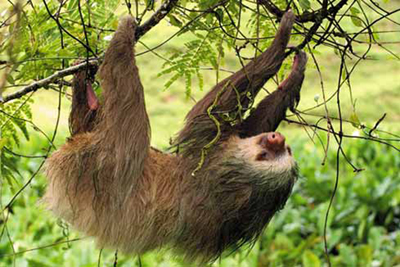 The sloth is one of the more unusual animals in the rainforest, and it is encountered frequently in most parts of rural Costa Rica. Two species of sloth can be observed – the three-toed (Bradypus variegatus) and the two-toed (Choloepus hoffmanni).
Sloths, whose diet consists primarily of leaves, live up to their name, sometimes remaining for days in the same tree and crawling slowly through the canopy when on the move. Though commonly seen in Cecropia trees, sloths actually have no special preference for the leaves of this widespread pioneer tree. Indeed, studies have shown individual sloths to feed on over 90 species of trees, and two-toed sloths will even occasionally eat insects and bird eggs.
The myth that sloths favor Cecropia trees is due simply to this tree species’ characteristic open branching structure, which makes sloths easier to spot in Cecropias than in other rainforest trees.
Sloths, or “lazy bears” as they are known in Spanish, often sport a greenish coat of algae on their grayish brown fur (thought to be a camouflage adaptation made possible by the physical structure of sloth hair), which harbors a number of moth and beetle species. One of the more interesting mysteries of tropical ecology is the sloth’s habit of climbing down a tree once a week or so to defecate, thus putting itself at considerable risk of predation by large forest mammals. A leading hypothesis suggests that this risk is outweighed by the fertilizer the sloth’s dung adds to its preferred food trees, but this behavior remains an enigma.
Sloths are the most abundant mammals in intact Central American rainforests, and in Costa Rica they are one of the few forest mammals whose survival actually may have been enhanced by forest fragmentation and habitat degradation. This is because sloths’ traditional predators are the jaguar and the harpy eagle, large animals that require extensive areas of undisturbed forest. The decline of the jaguar and harpy eagle has resulted in less risk to the sloth when it descends to defecate or ascends to sunbathe in the high treetops.
Be sure to keep an eye out for a two-toed or three-toed sloth when you land at your next NatureAir destination!
(506) 2257-4171
Toll Free: 1-877-281-8515
Costa Rica: (506) 2233-5151
Fax: (506) 2233-5284
E-mail: [email protected]
Costa Rica Hotels | Costa Rica Vacation Packages | Costa Rica Tours | Car Rental
Terms & Conditions | Privacy Terms | Contact Us | About Us | Comments & Reviews
The Costa Rica vacations planning site with information about accommodations, tours, transportation, maps of Costa Rica, main cities and travel tips.